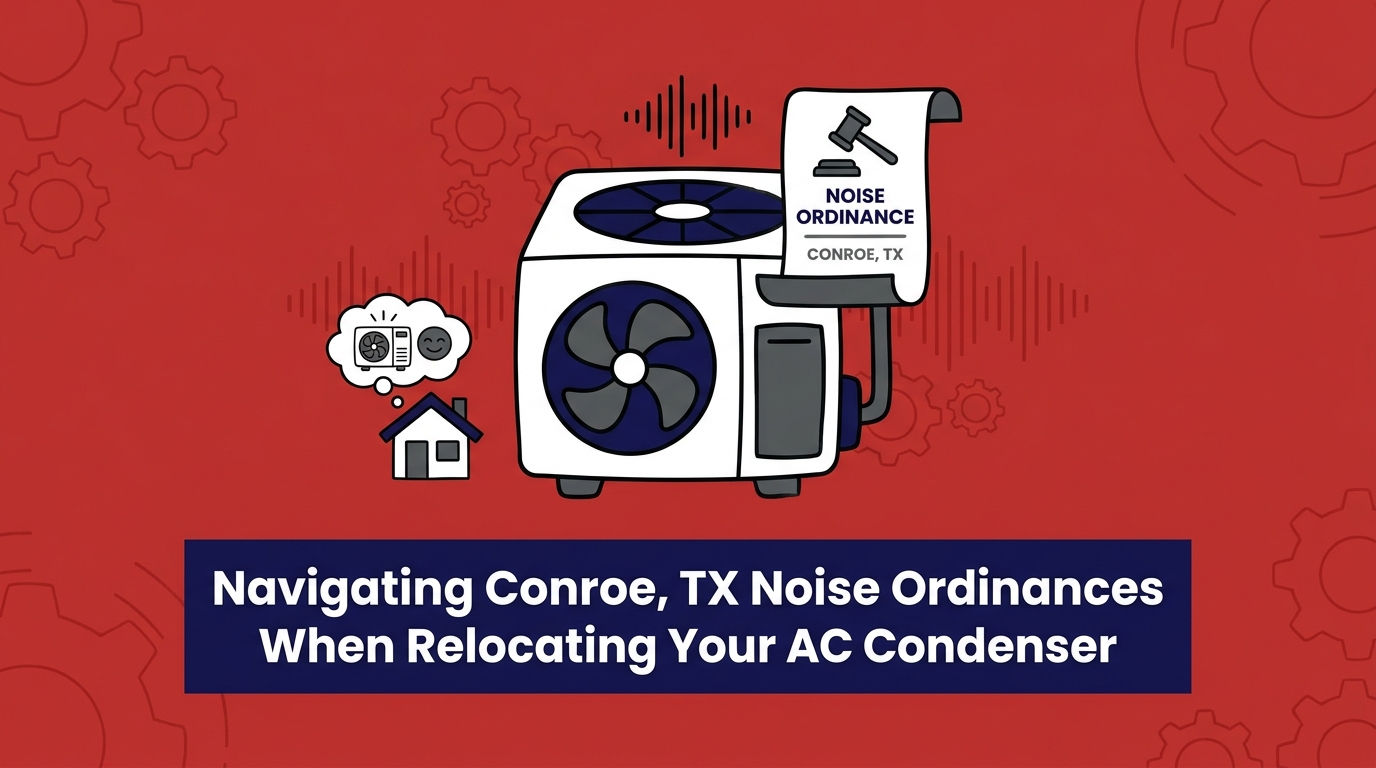

The Challenge of Relocating a Noisy AC Unit in Conroe
That constant, droning roar right outside your bedroom window makes sleeping nearly impossible, but navigating Conroe noise ordinances when relocating your AC condenser requires more than just shifting the equipment a few feet across the yard. When your outdoor unit is positioned poorly, the vibration and mechanical noise can penetrate exterior walls, turning your restful sanctuary into an acoustic nightmare. This frustration reaches its peak during the intense heat of a late-summer August, when peak cooling demands force the compressor and condenser fan to run continuously just to keep the indoor temperature bearable.
If you are exploring air conditioning services to finally move that disruptive unit, you are facing a critical decision point. Moving an air conditioner is not simply a matter of extending a few wires and copper pipes. It requires navigating strict municipal codes to ensure absolute legal compliance. A successful relocation balances the technical requirements of your HVAC system with the complex local property regulations enforced by the city.
Why the Noise Peaks in Late Summer
During the hottest months of the year, Conroe's hot, humid Texas summers force units to run continuously. This relentless operation means the outdoor condenser never gets a chance to rest. As the system works harder to reject heat into the already sweltering outdoor air, the internal components operate at maximum capacity. The resulting noise becomes a relentless neighborhood nuisance.
• Longer cooling cycles: The system runs for hours instead of minutes, creating a continuous hum.
• Increased fan speed: Variable-speed units will ramp up to their highest, loudest settings.
• Component strain: Aging parts rattle and vibrate more intensely when pushed to their limits in high temperatures.
The Legal Hurdle of Moving the Unit
You might think the easiest solution is to slide the unit to the far edge of your side yard. However, doing so without consulting local zoning laws can trigger a cascade of municipal violations. The city enforces strict decibel (dB) limits at the property line to prevent one homeowner's comfort from becoming another neighbor's headache. Proper relocation involves understanding both the spatial setbacks required by building codes and the acoustic limitations enforced by environmental ordinances.
Understanding Conroe's Residential Decibel Limits
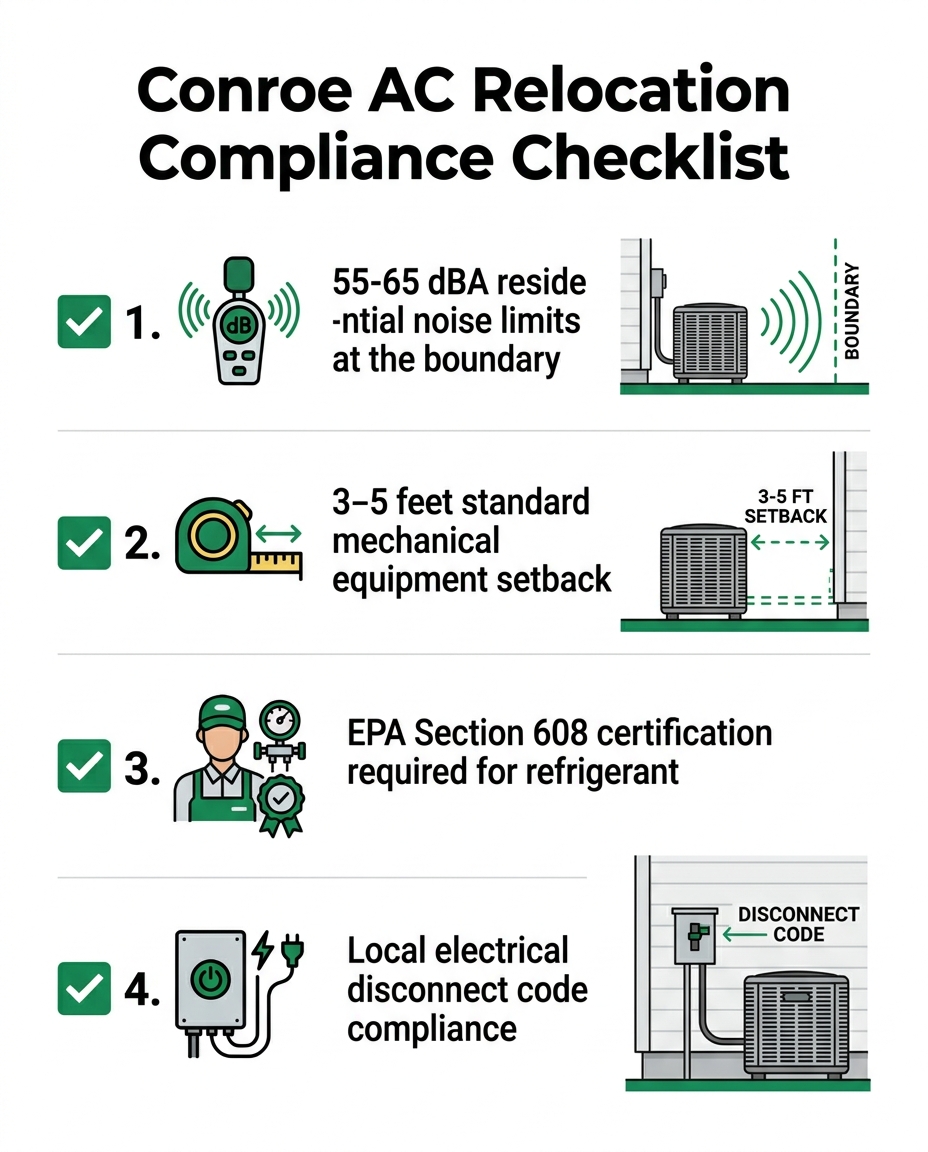
Before you can select a new location for your outdoor equipment, you must understand how the city regulates sound. Typical residential noise ordinances generally cap continuous sound at 55 to 65 decibels (dBA) during daytime hours, with even stricter limitations enforced after dark. These regulations exist to maintain a peaceful environment in densely packed residential subdivisions.
How Sound is Measured Legally
A common misconception is that the city measures the noise level right next to the air conditioner. In reality, enforcement officers measure decibel (dB) limits at the property line. This distinction is crucial. Sound dissipates over distance, meaning a unit that is incredibly loud up close might still be legally compliant if it is placed far enough away from the boundary separating your yard from your neighbor's.
To put these numbers into perspective, consider how everyday sounds compare to municipal limits:
• Normal Conversation — Estimated Decibel Level (dBA): 50 - 60 dBA — Legal Status in Residential Zones: Well within legal limits
• Modern, Efficient AC Unit (at 10 feet) — Estimated Decibel Level (dBA): 55 - 65 dBA — Legal Status in Residential Zones: Usually compliant at the boundary
• Aging, Failing AC Compressor — Estimated Decibel Level (dBA): 70 - 80+ dBA — Legal Status in Residential Zones: Likely violates property line limits
• Lawnmower or Power Tools — Estimated Decibel Level (dBA): 90 - 100 dBA — Legal Status in Residential Zones: Permitted only during daylight hours
When Normal Operation Becomes a Code Violation
Older, failing units often exceed these residential limits. As fan motors wear out and compressor bearings begin to grind, the acoustic output of the machine spikes dramatically. If you notice your AC making strange noises, it is not just a sign of impending mechanical failure; it is a potential code violation waiting to happen. These excessive noises frequently prompt neighbor complaints, which can lead to official code enforcement action and mandatory compliance deadlines.
Relocating the unit further from the boundary line is often the most effective way to bring the property back into compliance. By increasing the distance between the noise source and the legal measurement point, the sound waves have more physical space to dissipate before reaching the neighbor's yard.
Property Line Setbacks and Mechanical Equipment Clearances
Meeting the acoustic requirements is only half the battle. You must also satisfy the spatial and zoning requirements dictated by local building codes. Municipalities mandate standard property line setbacks for all permanent mechanical equipment. In most residential areas, this typically requires 3 to 5 feet of absolute clearance from the boundary line to the edge of the condenser pad.
City Setbacks vs. HOA Restrictions
While the city establishes the baseline rules, your specific neighborhood might have even tighter restrictions. Homeowner Association (HOA) architectural committees frequently enforce additional placement rules that override standard municipal codes. An HOA might dictate that equipment must be hidden from street view, placed behind a specific type of fence, or set back 10 feet instead of the city's required 5 feet. You must always verify that your new location satisfies both the city's decibel (dB) limits at the property line and the neighborhood's visual guidelines.
Airflow Requirements for the Condenser
Beyond legal boundaries, you must respect the manufacturer-specified airflow clearances. An air conditioner cools your home by absorbing indoor heat and exhausting it outside. If the unit cannot breathe, it cannot function. Placing the unit in a tight side-yard to hide it from neighbors can cause severe secondary issues.
The dangers of restricted airflow include:
• System overheating: Without adequate space to exhaust hot air, the compressor will overheat and shut down on thermal overload.
• Noise reverberation: Placing a unit between two close brick walls creates an echo chamber, amplifying the noise and violating ordinances.
• Reduced lifespan: A suffocating system works twice as hard, leading to premature mechanical failure and costly replacements.
A successful relocation finds the perfect balance: far enough from the property line to satisfy legal setbacks, but open enough to allow massive volumes of air to flow freely through the condenser coils.

How Moving Your Condenser Affects System Efficiency
Bridging the gap between legal compliance and HVAC technical performance is a delicate process. Moving a unit to satisfy setback codes often changes the total length of the refrigerant line-set—the paired copper pipes that connect the indoor evaporator coil to the outdoor condenser. This physical change directly impacts how efficiently your system can cool your home.
The Role of Refrigerant Line-Sets
The compressor acts as the heart of your air conditioning system, pumping pressurized refrigerant through the copper lines. When you move the outdoor unit further away from the house to comply with a late-summer August noise complaint, you inherently increase the distance that refrigerant must travel. Every additional foot of copper piping adds friction and resistance to the system.
Compressor Workload and Efficiency Drops
Excessive line-set lengths force the compressor to work substantially harder to push the fluid through the extended circuit. If the lines are stretched beyond the manufacturer's maximum allowed length, the system will suffer a severe drop in overall cooling efficiency. The air coming out of your vents will feel less cold, and your monthly energy consumption will spike as the system struggles to keep up with the thermostat setting.
Real-world placement issues can severely impact home comfort. One homeowner dealing with a post-Harvey house experienced severe temperature imbalances, with a 30-degree difference between floors. By designing and installing a newly routed, highly efficient HVAC system, the airflow was balanced, resulting in a quiet, properly cooled home. This demonstrates why the technical necessity of recovering existing refrigerant and properly sizing the new copper lines cannot be ignored. A well-planned relocation balances strict legal compliance with optimal system performance.
Why AC Relocation Requires Professional, By-the-Book Execution
Moving an AC condenser is absolutely not a DIY project. The process involves handling high-voltage electrical currents and highly pressurized, environmentally hazardous chemicals. Attempting to drag the unit across the yard yourself will result in ruptured lines, electrical fires, or severe physical injury.
The Dangers of Amateur Relocation
When a faulty unit fails in the middle of intense Texas heat, immediate action is required. One local homeowner faced a complete breakdown and reached out for help; a technician arrived the same day, diagnosed the underlying electrical faults, and repaired the system correctly to restore safe operation. This level of expertise is mandatory when relocating a system. Professional execution prevents costly municipal code violations and ensures the equipment operates safely.
The professional relocation process involves strict adherence to safety protocols:
1. Refrigerant Recovery: Technicians must use specialized recovery machines to safely extract the chemical coolant. Venting refrigerant into the atmosphere is a direct violation of EPA Section 608 requirements and carries massive federal penalties.
2. Electrical Disconnect Relocation: The high-voltage service whip and the safety disconnect box must be physically moved and rewired to meet current municipal building codes at the new location.
3. Line-Set Fabrication: New copper lines must be brazed with an oxy-acetylene torch while flowing nitrogen to prevent internal oxidation, ensuring the pipes remain clean and leak-free.
4. System Evacuation and Recharging: A vacuum pump is attached to remove all non-condensable gases and moisture from the lines before the exact, factory-specified weight of refrigerant is reintroduced.
The Value of Strict Discipline
Meeting the decibel (dB) limits at the property line requires precision. Working with a veteran-owned company means you are getting the same level of discipline and accountability that military service demands. This commitment to strict, by-the-book compliance ensures that every electrical connection is secure, every copper weld is flawless, and every municipal setback is honored, providing you with ultimate peace of mind.
Navigating Compliance Across Montgomery County Neighborhoods
While the City of Conroe has specific municipal codes, the broader region presents a patchwork of varying regulations. Surrounding unincorporated areas, distinct townships, and extraterritorial jurisdictions (ETJs) often have entirely different rules regarding exterior mechanical equipment.
Deed Restrictions and Architectural Committees
Master-planned communities across the region frequently enforce strict visual and acoustic guidelines that go far beyond standard city limits. These neighborhoods utilize architectural control committees to preserve property values and neighborhood aesthetics. Before approving a new condenser location, homeowners are strongly advised to verify both city ordinances and individual deed restrictions. Failing to secure HOA approval before pouring a new concrete pad can result in fines and a mandate to move the equipment a second time.
The Value of Local Zoning Knowledge
Because regulations shift dramatically from one subdivision to the next, working with a contractor who understands the nuances of Montgomery County service areas is invaluable. A local expert will know which neighborhoods require acoustic blankets, which townships demand specific property line setbacks, and how to position the unit to ensure the decibel (dB) limits at the property line are never breached.
Addressing Secondary HVAC Issues During a Relocation
Relocating your condenser provides a unique, natural transition to check other vital system components. Because the unit must be completely disconnected from power and pumped down (emptied of refrigerant) to facilitate the move, the internal components are easily accessible for a thorough inspection.
Preventative Maintenance Saves Future Headaches
Pumping down the system is an ideal time to inspect aging components that might otherwise go unnoticed until they fail during a late-summer August heatwave. When the cabinet is open and the power is severed, technicians can safely test the electrical and mechanical parts that endure the most wear and tear.
Key components to evaluate during a relocation include:
• Condenser Fan Motor: If you have previously researched an AC fan not working, you know this motor is critical for heat exhaust. Checking the bearings now prevents a sudden failure later.
• Electrical Contactors: These high-voltage switches frequently suffer from pitted or burned contacts due to thousands of on/off cycles.
• Dual Run Capacitors: These components store the electrical charge needed to start the compressor. Testing their microfarad readings ensures they are still holding a full charge.
• Condenser Coils: With the unit disconnected, the exterior coils can be deeply cleaned to remove years of impacted dirt, cottonwood, and lawn clippings.
Resolving these minor, secondary issues while the unit is already dismantled prevents unexpected breakdowns later in the season. Proactive maintenance during the physical move saves significant time and eliminates the need for future, standalone service call fees.
Ensure a Code-Compliant AC Relocation Today: Navigating Conroe Noise Ordinances When Relocating Your AC Condenser
Navigating property line setbacks, HOA restrictions, and municipal noise codes does not have to be an overwhelming ordeal when you have the right expert guidance. By understanding the strict decibel (dB) limits at the property line and the technical limitations of your refrigerant line-sets, you can make an informed decision about where your equipment truly belongs.
If the constant roar of your outdoor unit is ruining your sleep or triggering complaints from the neighbors, it is time to seek a professional assessment of your property lines and current AC setup. Proper planning ensures that your relocated system runs at peak efficiency without violating local laws. Reach out for a comprehensive consultation regarding AC repair and relocation in Conroe to plan a legal, efficient move that restores quiet comfort to your home.
Frequently Asked Questions
What is the decibel limit for AC units at the property line in Conroe?
Typical residential noise ordinances cap continuous sound at 55 to 65 decibels (dBA) during the day, with stricter limits at night. These limits are strictly enforced to prevent mechanical noise from disturbing neighboring properties. Aging units that rattle or grind frequently exceed these legal thresholds.
How far does an AC unit need to be from the property line?
Standard municipal building codes usually require mechanical equipment to maintain a 3 to 5-foot setback from the boundary line. However, this distance can increase if the unit is exceptionally loud or if local HOA regulations demand further concealment. Always verify exact setback requirements with your specific township or neighborhood association before pouring a new pad.
Do I need a permit to move my outside AC unit in Montgomery County?
Yes, relocating an outdoor condenser generally requires a permit because it involves altering high-voltage electrical disconnects and handling regulated refrigerants. Municipal inspectors must verify that the new location meets all safety codes and spatial setbacks. Skipping the permitting process can result in heavy fines and complications when selling your home.
Why is professional relocation required for AC condensers?
Moving a condenser requires recovering pressurized refrigerant, which is mandated by federal EPA Section 608 laws to prevent environmental contamination. Additionally, the process involves brazing new copper lines and rewiring 240-volt electrical circuits. Attempting this without professional licensing poses severe safety risks and guarantees system failure.
How do you measure decibel limits at the property line?
Code enforcement officers use calibrated sound level meters placed exactly at the legal boundary separating the two properties. They measure the sustained acoustic output over a specific period, rather than a brief momentary spike. The reading is taken from the property line, not directly next to the air conditioner cabinet.
Can my HOA prevent me from moving my AC unit?
Yes, an HOA architectural control committee has the authority to deny a relocation request if the new placement violates their visual or acoustic guidelines. Many master-planned communities require outdoor equipment to be completely shielded from street view by approved fencing or landscaping. You must submit your relocation plan to the HOA for written approval before beginning any physical work.